Instrument Rating package
- 20 hours of flight time
- 10 hours in our simulator
- Ground instruction
$7,999
We confirm in writing what your package includes and any separate costs before you start.

Instrument Rating · IFR training
Learn to fly in clouds and low visibility by reference to your instruments. You train one-on-one with a CFII, in the airplane and in our simulator, at Northeast Philadelphia Airport.
What the rating lets you do
An instrument rating lets you fly under instrument flight rules (IFR). You can fly through clouds and low visibility, guided by your instruments and air traffic control.
You need an instrument rating to act as pilot in command under IFR, or in weather below VFR minimums (14 CFR 61.3(e)).
A commercial pilot without an instrument rating cannot carry passengers for hire at night, or on cross-country flights beyond 50 nautical miles (14 CFR 61.133).
That is why our training path puts the instrument rating before the commercial certificate.
Commercial pilot trainingInstrument training sharpens everything. You learn precise control, careful planning and clear radio work with ATC.
Who it's for
This rating is for private pilots who want a more useful certificate, and for anyone on the path to a flying career.
You can start instrument training after your private pilot certificate. You do not need every required hour in your logbook on day one. You need them before your instrument checkride.
Syllabus
Instrument training builds in four blocks, and each one adds to the last. The simulator lets you practice many of these tasks before you fly them in the airplane.
Attitude instrument flying, partial-panel flying and recovery from unusual attitudes.
VOR and GPS navigation, IFR clearances, departure and arrival procedures, and holding patterns.
Precision and non-precision approaches, including ILS and GPS, plus missed approaches.
IFR flight planning, weather decisions, the long cross-country and checkride preparation.
From our classroom
Watch an instrument class on holds, part of the navigation block above. More classes are free on our ground school page.
All ground school videos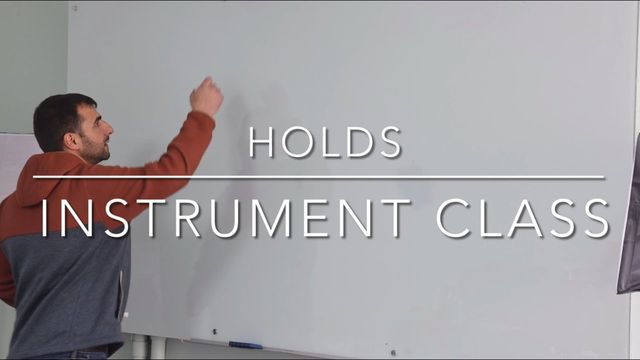
An instrument class on flying holds.
Simulator and airplane
Your package includes 10 hours in our simulator, an aviation training device. It works alongside 20 hours of flight time in the airplane.
In the simulator you can pause a lesson, reset an approach and fly it again. You can learn a new procedure without spending airplane time or waiting on the weather.
Then you fly that procedure in the airplane with your CFII. There you add real air traffic control, real wind and real workload.
FAA rules let a limited amount of time in an approved training device count toward the instrument time requirement (14 CFR 61.65). We show you how your simulator time is logged.
Freeze a scenario, talk it through with your CFII, then fly it again.
Rehearse instrument and system failures on the ground before you face them in the air.
Each skill moves into your 20 hours of flight time, where the workload is real.
How training works at GQ
We train under FAA Part 61. Your plan is built around the hours you already have, your schedule and your goals.
Instrument flying rewards preparation. That is why every flight lesson starts with a briefing on the procedure you are about to fly. It ends with a debrief on what to study next.
Instructor credentials on our staff include ATP, CFI, CFII, MEI and AGI, and our checkride sign-offs are led by an FAA Gold Seal flight instructor. Your instrument flight training is with a CFII. The FAA requires at least 15 hours of your instrument training to be with one (14 CFR 61.65).
Where you train
You train from Northeast Philadelphia Airport (KPNE), a towered Class D airport beneath Philadelphia's Class B airspace.
Talking with air traffic control is part of every flight here. That steady practice builds the radio skills at the heart of IFR flying.
Your package includes 20 hours of flight time in one of our airplanes. Ask us which airplane fits your plan.
Simulator sessions are in our aviation training device. Your package includes 10 hours in it.
See the fleetGQ training package
Your package bundles flight time, simulator time and ground instruction for one published price.
The FAA asks for 40 hours of actual or simulated instrument time in total (14 CFR 61.65). Instrument time you have already logged, such as during private pilot training, can count toward it.
Bring your logbook when you talk with us, and we will show you how your hours fit. Before you start, we confirm in writing what your package includes and any separate costs, such as FAA test and examiner fees. Packages can't be refunded once training has started.
We confirm in writing what your package includes and any separate costs before you start.
Timeline
It depends on where your logbook stands and how often you fly.
If you already have your 50 hours of cross-country time, you can focus on instrument skills. If you still need some, your CFII helps you plan how to build them alongside your instrument work.
Weather plays a part too. Simulator sessions do not depend on the weather, which helps keep your training moving.
What comes next
Our training path runs Private, then Instrument, then Commercial, then Multi-Engine. The instrument rating sets you up for the professional steps.
With an instrument rating, your commercial certificate avoids the 61.133 limitation. That limit bars carrying passengers for hire at night or on cross-country flights beyond 50 nm.
Explore commercial pilot trainingTake your instrument skills into a twin. We train multi-engine pilots in our Piper Seneca.
Multi-engine ratingInstrument training builds on your private pilot certificate. Begin there if you are new to flying.
Private pilot trainingInstrument rating FAQ
Have a question we didn't cover? Call (215) 839-8507 or read our main FAQ.
No. You need it before your instrument checkride, not before your first lesson. Your CFII will help you plan how to meet the 50-hour requirement in 14 CFR 61.65.
Your package includes 10 hours in our simulator. FAA rules allow a limited amount of time in an approved training device to count toward the instrument requirements (14 CFR 61.65). We show you exactly how your simulator hours are logged.
You can take it once your instructor endorses you, at any point before your checkride. Taking it early lets the knowledge support your flying. The checkride must come within 24 calendar months of passing it (14 CFR 61.39).
For a flying career, we recommend it. Without an instrument rating, a commercial pilot cannot carry passengers for hire at night or on cross-country flights beyond 50 nm (14 CFR 61.133). Our path runs Private, Instrument, Commercial, then Multi-Engine.
To fly IFR as pilot in command, you need recent instrument experience (14 CFR 61.57(c)). Within the preceding 6 calendar months, you must log six instrument approaches, holding procedures, and intercepting and tracking courses. Ask us about staying sharp after your rating.
Before you start, we confirm in writing what your package includes and any separate costs, such as FAA test and examiner fees. Packages can't be refunded once training has started.
Tell us where your logbook stands, and we'll map out your instrument training.